The artist reveals how prosthetic artistry is about more than precision: it is a practice of dignity, care, and representation, at its most powerful when it disappears.

The artist reveals how prosthetic artistry is about more than precision: it is a practice of dignity, care, and representation, at its most powerful when it disappears.
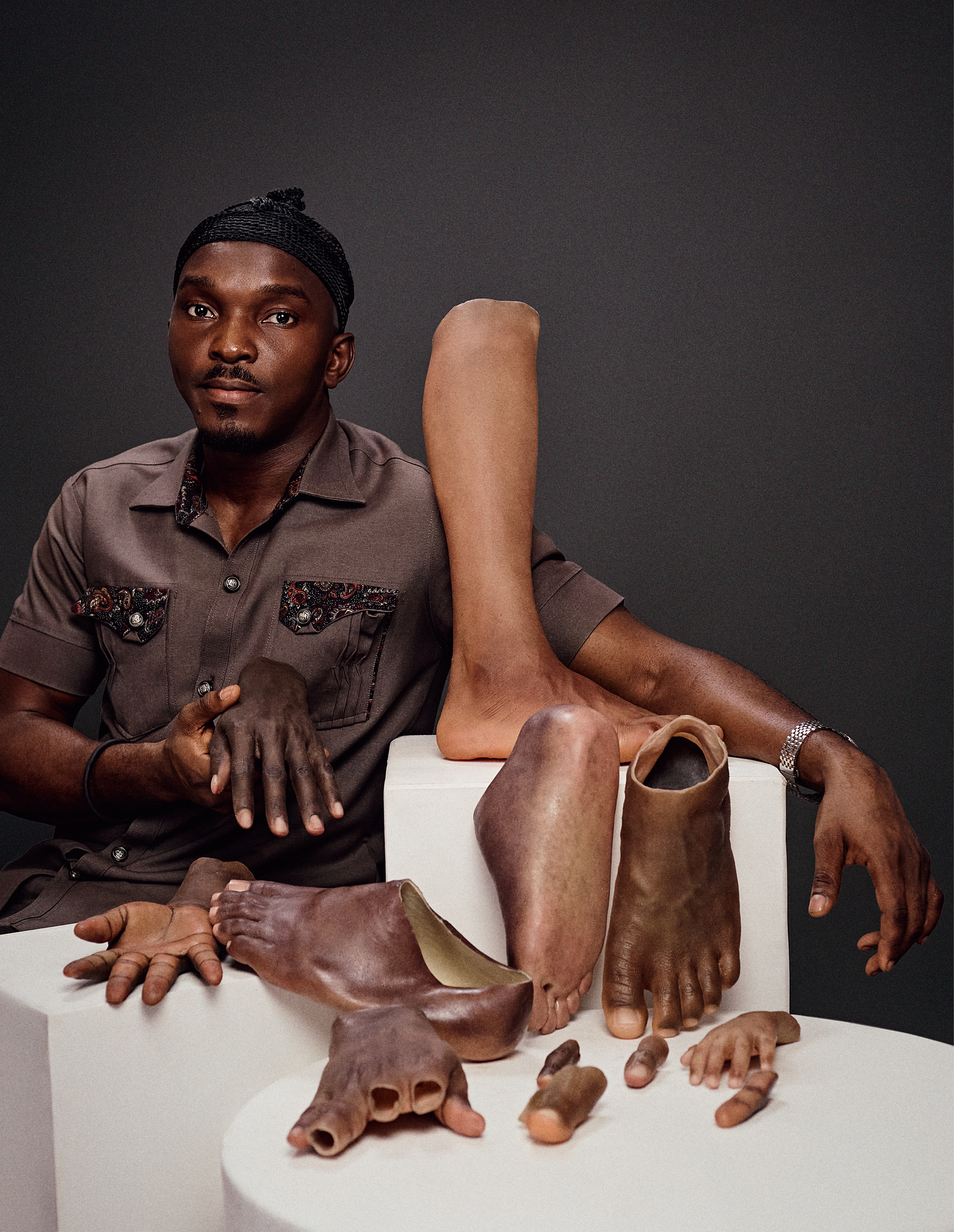
PHOTO: JUDESON ATAISI
John Amanam sounds like a craftsman on the video call: precise, calm, matter-of-fact. On his head, he wears a red, black, and white striped Okpu-Agụ cap with a tassel. In Akwa Ibom and parts of Cross River State, it is worn primarily by men who have been initiated into a traditional community. Amanam, as a priest, is part of an indigenous faith tradition in which he leads rituals and ceremonies. Then he speaks about what, ideally, remains invisible in his work: prosthetics.
The trained sculptor from Uyo, near the Atlantic coast in southern Nigeria, spent years creating special effects for Nollywood, Nigeria’s film industry. Today, he reconstructs body parts so realistically that they go unnoticed in everyday life, especially where, for a long time, suitable solutions for dark skin tones were scarcely available.
Becoming a prosthetic artist was never his plan. When his brother loses four fingers in a fireworks accident and there is no prosthesis whose shape, design, and color truly match, the subject becomes a mission for the 38-year-old. “I wanted something that would compensate for his loss and help him feel confident again,” Amanam says. That first finger prototype became the foundation for “Immortal Cosmetic Art,” the studio he founded in Uyo in 2000.
Amanam speaks about skin tone the way others speak about character. If the color is off, those affected feel uncomfortable, afraid of stares, afraid of being exposed. At first, he asked painting specialists, but no one could offer him the hyper-realism he was looking for. So he taught himself: color matching and nuance. His benchmark: below an 85 percent match, prostheses look artificial, not like skin. In the end, pigmentation is decisive. Amanam and his team work with silicone, combined with other materials; mistakes can hardly be corrected.
In the studio, everything runs like clockwork: taking measurements, making impressions, creating molds, capturing skin tone and color, casting, and corrections. Amanam leads a 15-person team; overall, the company has 25 employees. Every prosthesis is closely checked after individual production: for durability, heat resistance, skin compatibility, proportions, and exact measurements. Despite the team, each piece remains custom work: demanding, but fulfilling. It is not mainly about money, he says, but about solving challenges together and delivering.
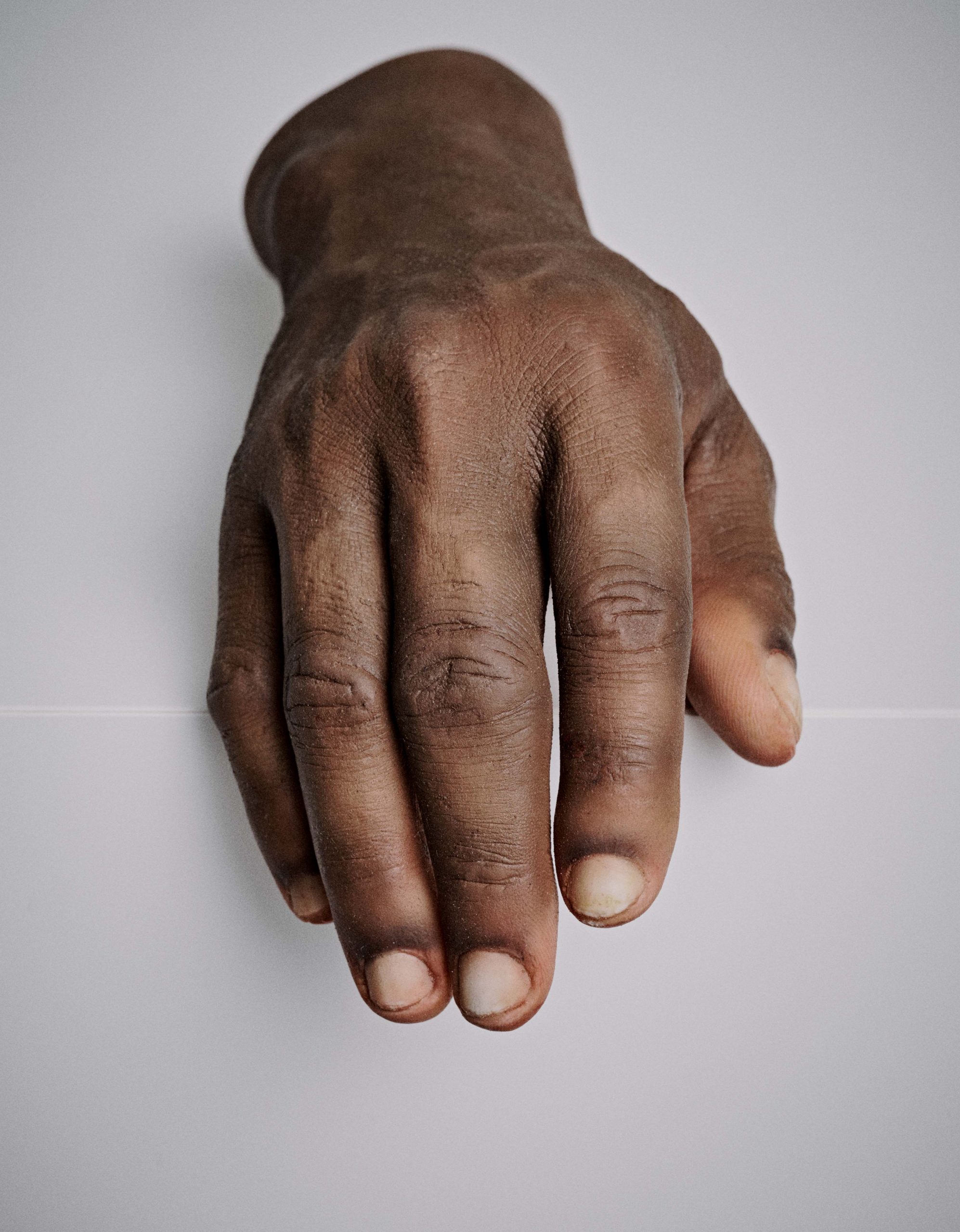
PHOTO: ARMIN MORBACH
Amanam repeatedly speaks about access. Prostheses should also be made in Africa and be affordable for everyone. Not just for a high-tech elite, but for people who want one thing above all: to feel confident among others again. Clients from more than 60 countries have already reached out, mostly directly, partly through hospitals, orthopedic clinics, or organizations. Since 2019, his team has accompanied more than 5,000 people, he says.
How real his illusions are is shown by an episode from Ghana in 2021: an upper-arm prosthesis is stopped at the airport. Officials cut deep into the silicone to make sure it is not a real body part. Amanam makes it again and later delivers it in person. The damaged original is later auctioned after an exhibition in France. The scene tells you everything about his work: so close to reality that it unsettles, and at the time so rare that a crime was suspected before a prosthesis.
When those affected “recognize” themselves again for the first time, he says, many cry. Others hide their tears, take a photo, and send it to family or close friends. In that moment, aesthetics cease to be surface and become necessity and relief: no more hiding, no more explaining, being able to take part in life again.
Alongside prosthetics, other art is also created in his studio, and with his team, the “Amanam Terracottas,” he documents archaeological finds from Akwa Ibom. In parallel, he is developing bionic arms (“Ubokobong Arms,” “Hand of God” in Ibibio) that are controlled via brain signals. In 20 years, he says, he primarily wants to supervise and continue researching.
His work is most beautiful when you can’t see it.
EDITOR: NOSA IMAFIDON
PROSTHETIC ARTIST: JOHN AMANAM
PHOTOS: JUDESON ATAISI & ARMIN MORBACH
April 11, 2026